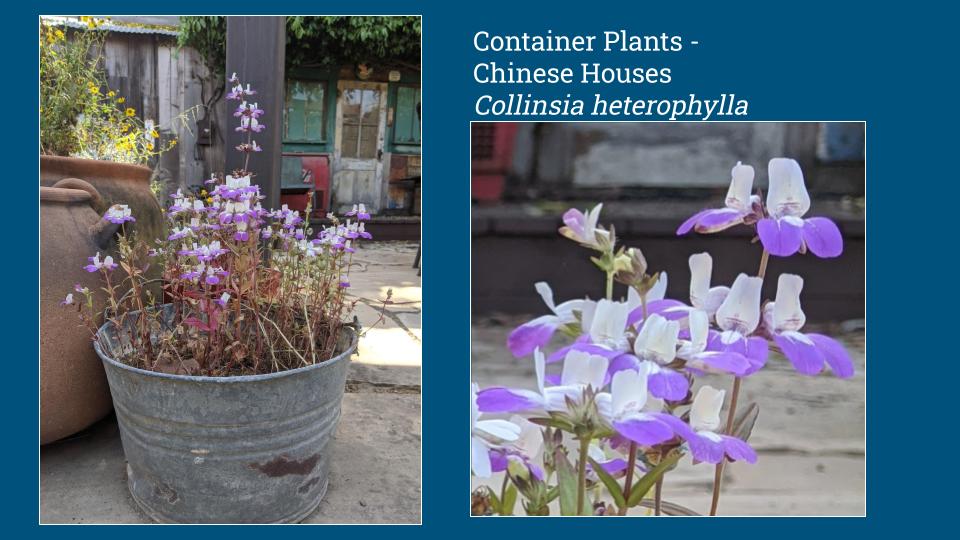
This weekend we got the first rain of the 2020-21 season. I took advantage of this to sow some wildflower seeds and bulbs and to plant some plants. The seeds included arroyo lupine (Lupinus succulentus), Chinese houses (Collinsia heterophylla), owl's clover (Castilleja exserta), and some others. The bulbs were splendid mariposa lily (Calochortus splendens). I have no pictures of these because there is nothing to see yet.
Last week I bought a few plants from the annual CNPS sale. My timing was good for getting them planted before the rain arrived. I put three of them in containers. First is showy penstemon (Penstemon spectabilis). It is found from the mountains to the coast and from Ventura County down into Baja. Of course it has no flowers yet. Following that are some of my photos of P. spectabilis in the wild in San Diego County.
The second of my new plants is conejo buckwheat (Eriogonum crocatum), a rare species that is found only in a small area on the Ventura County/L.A. County boundary. It has nearly white foliage and yellow flowers, which will make a really nice color combo in a terra cotta pot.
Plant number three is scarlet monkeyflower (Erythranthe cardinalis). It's a plant that is usually seen in streams, so I put it in a pot that doesn't have a drainage hole in the bottom. I'll be able to keep it consistently wet without using too much water.
Below is a photo I took recently of E. cardinalis in the wild. When kept moist it produces blooms for a long time.
Now, here are three plants I put in the ground. They are less showy but still very valuable plants. Below is salt marsh fleabane (
Pluchea odorata), another plant that likes damp soil but is not as thirsty as scarlet monkeyflower.
Here's a photo I recently took of a wild Pluchea odorata in bud.
Lately I've been seeing a lot of sawtooth goldenbush (Hazardia squarrosa) while hiking, so I decided to buy one for my garden. The photo below shows it, followed by one I observed in the wild.
.

Lastly is seacliff buckwheat (Eriogonum parvifolium). In the wild it is found strictly on the coast, from San Francisco down into Baja. I had one years ago but then had to take it out for various reasons, and since then I have wanted to get another one. It is quite low growing, forming a mat that is essentially a ground cover. It has small white flowers, but I value it mostly for the foliage - small, rounded, shiny leaves. Also, its roots are excellent at holding soil on bluffs to prevent erosion. It's a plant that should be used all along our coast.
My next post will discuss the response to first rain by established, mature plants.