Things are changing fast in the world of Bark Lice. I noticed today (9/6/14) that the patch looked a little different. I investigated to see what might be going on.
Clearly, some of the nymphs have transformed into winged adults. Some have probably already flown away, making the patch appear less dense and less uniform. I had not expected this to happen so soon. I thought it might take a couple of weeks for them to go through this process, but instead it has taken only a few days. Below is a close up.
In the bottom left corner of this shot we see what I believe is the shed carapaces of two nymphs that have just emerged as adults. My guess is that the adults will now mate and the females will lay eggs around or on the tree where they will stay dormant until next Spring or Summer. I don't know how long the adults live, but I would imagine they die when the weather turns chilly, if not sooner. Once again, I feel so privileged to be able to witness this phenomenon in my own front yard.
Saturday, September 6, 2014
Friday, September 5, 2014
Bark Lice
I'm a terrible blogger. I haven't posted anything since January, and there was plenty to write about. I just didn't get around to posting any of it. Well, today is different because there is a population explosion of insects on my coast live oak (Quercus agrifolia). From inside the house it looked like a wet spot on the lower trunk of the tree. When I went outside to take a closer look, I saw that it was a mass of tiny insects huddled in a fairly tight cluster. I took a number of pictures, trying to get as much magnification as possible because the insects are very tiny, only about 1-2 mm in length.
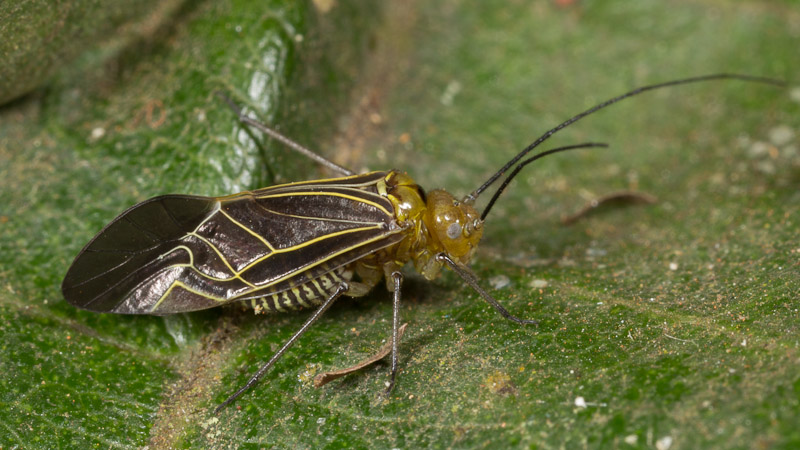
I sent the photos around to a couple of different insect experts for identification. The unanimous answer I got from them was that these are called Bark Lice (Order Psocoptera). However, they are not true lice, nor are they bees, despite the superficial resemblances. They are fairly common in and under trees. They are not harmful in any way and may be considered beneficial in the big picture. They eat molds, pollen, and various other kinds of organic matter, so they are part of the large and important group of decomposers who help keep the world from being buried in debris.
These nymphs will grow and go through several molts, eventually emerging as winged adults. For a picture of the adult, see http://naturecloseups.com/wp-content/uploads/2012/02/00075806.jpg. Until now, I was unaware that this group of insects even existed. Now I am delighted to have them living in my yard, and I hope they will become permanent residents. I believe this has occurred due to the combination of native plants and totals absence of pesticides. While a native plant garden can never be considered a truly complete ecosystem, the appearance of species like this brings a level of ecological complexity that is very gratifying.
I sent the photos around to a couple of different insect experts for identification. The unanimous answer I got from them was that these are called Bark Lice (Order Psocoptera). However, they are not true lice, nor are they bees, despite the superficial resemblances. They are fairly common in and under trees. They are not harmful in any way and may be considered beneficial in the big picture. They eat molds, pollen, and various other kinds of organic matter, so they are part of the large and important group of decomposers who help keep the world from being buried in debris.
These nymphs will grow and go through several molts, eventually emerging as winged adults. For a picture of the adult, see http://naturecloseups.com/wp-content/uploads/2012/02/00075806.jpg. Until now, I was unaware that this group of insects even existed. Now I am delighted to have them living in my yard, and I hope they will become permanent residents. I believe this has occurred due to the combination of native plants and totals absence of pesticides. While a native plant garden can never be considered a truly complete ecosystem, the appearance of species like this brings a level of ecological complexity that is very gratifying.
Sunday, January 5, 2014
More on Mychorrhizal Fungi
I concluded my last post with a discussion of beneficial soil fungi and their relationship with green plants, a relationship that is known as mychorrhizal. I was planting some new ferns today and dug up an area where the fungal hyphae were very evident. They are the bright white, stringy things in the photo below.
I mentioned that it is important to avoid excessive digging because that disrupts the mychorrhizal network, and you can see why. However, occasional digging in a small area to plant something new is not going to do much damage.
Wikipedia has an excellent discussion of mychorrhizal fungi:
http://en.wikipedia.org/wiki/Mycorrhiza#Ectomycorrhiza. I highly recommend it for anyone interested in learning more about this important botanical function. There are literally dozens of fascinating and amazing things to learn about how plants and fungi can work together.
A few days later I was working in another part of the yard and found the mushrooms below, covered by leaf mulch. The largest ones are about the size of a quarter and they are very bizarre. I've never seen anything like them before.The caps of the mushrooms are concave, unlike most other mushrooms. They are on the north side of the house so they are in shade almost all the time.
I've been looking on the internet to try to identify this weird fungus and the most I can say at this point is that it appears to be a type of cup fungus. I will be contacting the San Diego Mycological Society (www.sdmyco.org) to see if they can help me with identification.
I mentioned that it is important to avoid excessive digging because that disrupts the mychorrhizal network, and you can see why. However, occasional digging in a small area to plant something new is not going to do much damage.
Wikipedia has an excellent discussion of mychorrhizal fungi:
http://en.wikipedia.org/wiki/Mycorrhiza#Ectomycorrhiza. I highly recommend it for anyone interested in learning more about this important botanical function. There are literally dozens of fascinating and amazing things to learn about how plants and fungi can work together.
A few days later I was working in another part of the yard and found the mushrooms below, covered by leaf mulch. The largest ones are about the size of a quarter and they are very bizarre. I've never seen anything like them before.The caps of the mushrooms are concave, unlike most other mushrooms. They are on the north side of the house so they are in shade almost all the time.
I've been looking on the internet to try to identify this weird fungus and the most I can say at this point is that it appears to be a type of cup fungus. I will be contacting the San Diego Mycological Society (www.sdmyco.org) to see if they can help me with identification.
Tuesday, December 31, 2013
More Stuff Starting to Bloom
We've had some warm weather the past several days and the result has been a number of plants deciding to bloom now. This seems really early to me, but maybe it's normal. So first we have Del Mar Manzanita (Arctostaphylos glandulosa ssp. crassifolia). This is a rare manzanita that occurs only near the coast in eroded sandstone soils between the Torrey Pines area and Carlsbad.
Next is Eriophyllum millefolium or Common Yarrow. The nursery had it labeled as ssp. lanulosum, but Calflora and JM2 do not seem to recognize any subspecies. I planted this one about a year ago, and it has turned out to be a nicely spreading ground cover with lacy, ferny foliage. I have it in part sun/part shade and it seems quite happy there. It appears fairly drought tolerant but definitely looks better with regular watering. It mixes well with Blue-eyed grass and Cinquefoil.
I've had a Cleveland sage, Salvia clevelandii, for many years. It is easy to grow, a very reliable bloomer and super fragrant. It thrives on neglect. The only thing it needs is cutting back every year or two so that it doesn't take over the whole yard.
Another early bloomer is Santa Cruz Island Gooseberry (Ribes thacherianum). It is drought deciduous and goes dormant in summer. With the first rains of fall it leaps back to life and puts out flowers almost immediately. They are small but delicate and beautiful. I also have several other Gooseberries. I mentioned that my R. indecorum is also blooming now. Others that have not bloomed yet are speciosum, malvaceum, sanguineum and viburnifolium.
The next couple of photos are of a completely different Kingdom, the Fungi. I used to view mushrooms in my garden as a sign that something was wrong. Mushrooms are the fruiting bodies of fungi that are living in the soil, and I thought that any fungus in the soil was bad. More recently I have learned that plants in undisturbed areas and in an established ecological relationship with each other are connected together by a beneficial fungal network in the soil.
The soil fungus and plants have a symbiotic relationship that is called mychorrizal. The minute hyphae (root-like structures) of the fungus are more efficient at infiltrating the soil and taking up water than the roots of green plants. In a mychorrizal relationship, the fungal hyphae connect with the roots of green plants and the fungus shares its water with these plants. In return, the green plants share some of their carbohydrates with the fungus, which the fungus cannot produce on its own because it has no chlorophyll. Studies have shown that over 90% of green plant families are mychorrhizal if conditions are right to allow soil fungi to thrive.
The gardener who wants to maintain an ecologically healthy garden will want to create the right conditions for mychorrizal fungi. What conditions are those? From a gardening perspective, the two things that are most important are to minimize soil toxins, particularly those that are fungicidal, and to minimize soil disturbance. The latter point means don't dig up the soil unnecessarily because doing so can sever the connection between soil fungi and your plants. It doesn't mean that you have to avoid digging entirely. Just don't get out the rototiller and turn over the soil every year, as recommended by some gardening "authorities." Having primarily plants native to your area should also help because the local fungi and local plants should already be acquainted with each other and should link up more readily. I also advocate leaving the leaf litter from your plants on the ground, and leave any mushrooms alone. They are actually a good sign that the mychorrizal network is starting to function.
Next is Eriophyllum millefolium or Common Yarrow. The nursery had it labeled as ssp. lanulosum, but Calflora and JM2 do not seem to recognize any subspecies. I planted this one about a year ago, and it has turned out to be a nicely spreading ground cover with lacy, ferny foliage. I have it in part sun/part shade and it seems quite happy there. It appears fairly drought tolerant but definitely looks better with regular watering. It mixes well with Blue-eyed grass and Cinquefoil.
I've had a Cleveland sage, Salvia clevelandii, for many years. It is easy to grow, a very reliable bloomer and super fragrant. It thrives on neglect. The only thing it needs is cutting back every year or two so that it doesn't take over the whole yard.
Another early bloomer is Santa Cruz Island Gooseberry (Ribes thacherianum). It is drought deciduous and goes dormant in summer. With the first rains of fall it leaps back to life and puts out flowers almost immediately. They are small but delicate and beautiful. I also have several other Gooseberries. I mentioned that my R. indecorum is also blooming now. Others that have not bloomed yet are speciosum, malvaceum, sanguineum and viburnifolium.
The next couple of photos are of a completely different Kingdom, the Fungi. I used to view mushrooms in my garden as a sign that something was wrong. Mushrooms are the fruiting bodies of fungi that are living in the soil, and I thought that any fungus in the soil was bad. More recently I have learned that plants in undisturbed areas and in an established ecological relationship with each other are connected together by a beneficial fungal network in the soil.
The soil fungus and plants have a symbiotic relationship that is called mychorrizal. The minute hyphae (root-like structures) of the fungus are more efficient at infiltrating the soil and taking up water than the roots of green plants. In a mychorrizal relationship, the fungal hyphae connect with the roots of green plants and the fungus shares its water with these plants. In return, the green plants share some of their carbohydrates with the fungus, which the fungus cannot produce on its own because it has no chlorophyll. Studies have shown that over 90% of green plant families are mychorrhizal if conditions are right to allow soil fungi to thrive.
The gardener who wants to maintain an ecologically healthy garden will want to create the right conditions for mychorrizal fungi. What conditions are those? From a gardening perspective, the two things that are most important are to minimize soil toxins, particularly those that are fungicidal, and to minimize soil disturbance. The latter point means don't dig up the soil unnecessarily because doing so can sever the connection between soil fungi and your plants. It doesn't mean that you have to avoid digging entirely. Just don't get out the rototiller and turn over the soil every year, as recommended by some gardening "authorities." Having primarily plants native to your area should also help because the local fungi and local plants should already be acquainted with each other and should link up more readily. I also advocate leaving the leaf litter from your plants on the ground, and leave any mushrooms alone. They are actually a good sign that the mychorrizal network is starting to function.
Thursday, December 26, 2013
Year-End Activity
Following up to my last post, here are more status reports on what I have been doing and what the plants have been doing as we approach the end of 2013. When I was at Tree of Life a couple months ago they had a plant that I have never heard of before and is not listed in their catalog. It is Munzothamnus blairii. I assume the genus is named after the famous botanist, Philip Munz. It seems to occur only on San Clement Island off the coast of San Diego County. It's an attractive plant so I bought it to add to the Channel Island section of the garden. It is in the Asteraceae family and has composite flowers, the ray flowers being pink to white. The leaves are also quite nice. Interestingly, this one was in bloom when I bought it and is continuing to put out new blooms. I'm excited about this one.
I also bought a couple of new cacti recently. The first one is a Cardon (Pachycereus pringlei). I bought it from Anderson's La Costa Nursery which is not a native plant nursery but occasionally has some California or Baja natives. This one was a good size (16 in.) and the right price. Cardons are slow-growing and so are usually somewhat pricey because the nurseries have to grow them for such a long time. Really old ones in Baja can be 60 ft. tall. This one is somewhat top heavy for its root system so I have it propped up for now.
I bought a couple more cacti from cactusbylin.com via ebay. They sell cacti and succulents from all over the world, including a number of California and Baja natives. I am super happy with the cacti that I got. The first one is a Cochemiea setispina from the mountainous region of central Baja. Although it is not a coastal species, I'm hoping it will do well in Encinitas. The thing I am most impressed with is the size of this specimen - 9 in. in diameter. Cochemieas are clumpers with multiple heads, like Echinocerus and some others. Mine has approximately 40 heads! If I wanted to put this in a container and take it to cactus shows, I'm sure it would be an award winner. But in want it in the ground in my Baja section. Note that I have used some bent wire coat hangers to pin it down until the roots become firmly attached to the soil. The Cochemieas have great flowers, and I'm looking forward to this one blooming.
The second one I bought from cactusbylin.com is a Ferocactus fordii from the coast of northern Baja. It is a smaller form of barrel cactus which I think will do well in a container. Again, this was a really nice size specimen for the price. I have bought other cacti from online dealers but they have always tended to be pretty small. I should also mention that these two were well packaged and delivered in great condition.
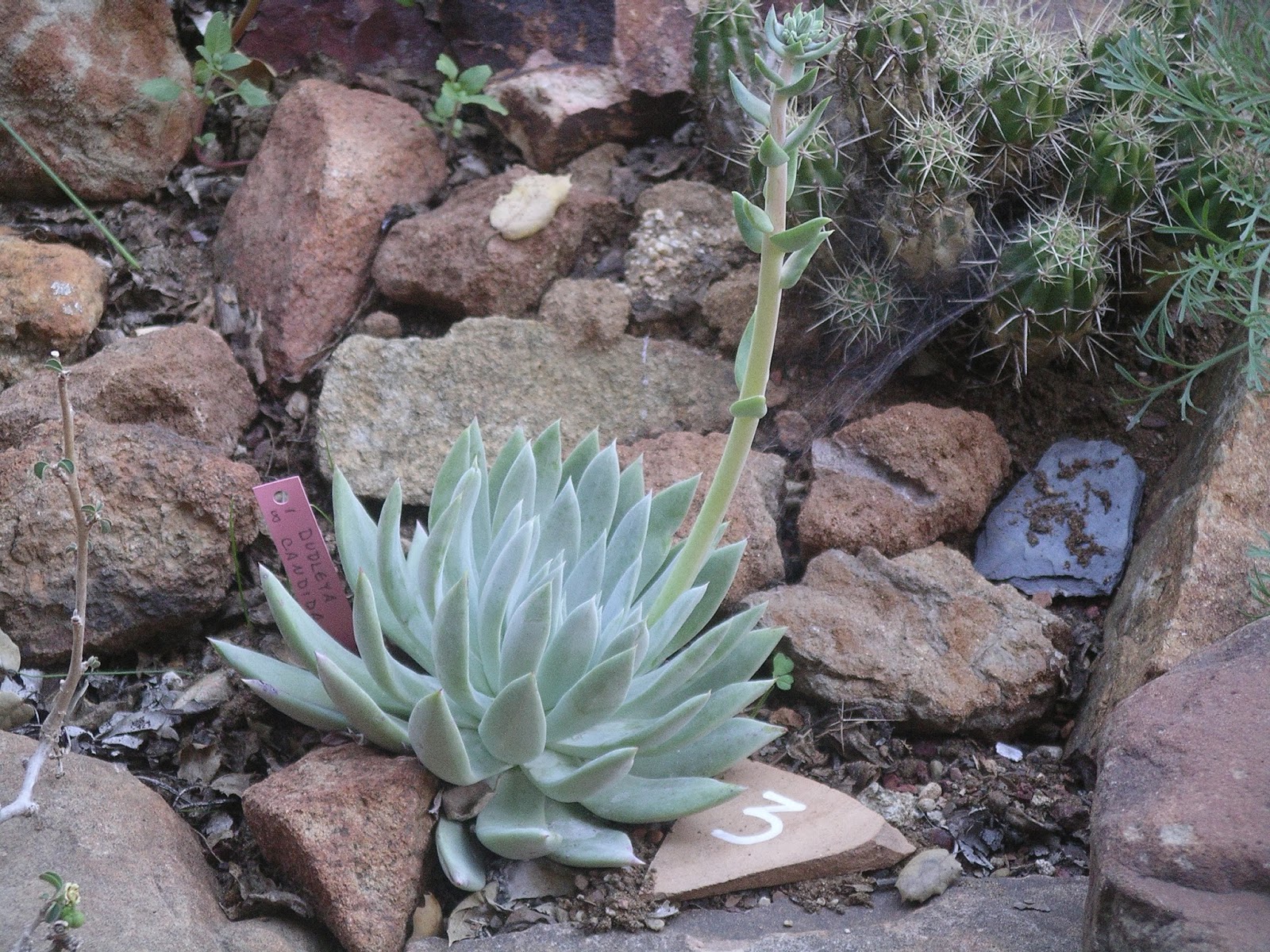
Although it's early in the season, a few plants are starting to bloom already. Below is a Dudleya candida that is putting up its inflorescence.
Next is a Dudleya brittonii putting up multiple inflorescences.
Last of the early bloomers in my garden is a Ribes indecorum that is covered with tiny white flowers from top to bottom.
I also bought a couple of new cacti recently. The first one is a Cardon (Pachycereus pringlei). I bought it from Anderson's La Costa Nursery which is not a native plant nursery but occasionally has some California or Baja natives. This one was a good size (16 in.) and the right price. Cardons are slow-growing and so are usually somewhat pricey because the nurseries have to grow them for such a long time. Really old ones in Baja can be 60 ft. tall. This one is somewhat top heavy for its root system so I have it propped up for now.
I bought a couple more cacti from cactusbylin.com via ebay. They sell cacti and succulents from all over the world, including a number of California and Baja natives. I am super happy with the cacti that I got. The first one is a Cochemiea setispina from the mountainous region of central Baja. Although it is not a coastal species, I'm hoping it will do well in Encinitas. The thing I am most impressed with is the size of this specimen - 9 in. in diameter. Cochemieas are clumpers with multiple heads, like Echinocerus and some others. Mine has approximately 40 heads! If I wanted to put this in a container and take it to cactus shows, I'm sure it would be an award winner. But in want it in the ground in my Baja section. Note that I have used some bent wire coat hangers to pin it down until the roots become firmly attached to the soil. The Cochemieas have great flowers, and I'm looking forward to this one blooming.
The second one I bought from cactusbylin.com is a Ferocactus fordii from the coast of northern Baja. It is a smaller form of barrel cactus which I think will do well in a container. Again, this was a really nice size specimen for the price. I have bought other cacti from online dealers but they have always tended to be pretty small. I should also mention that these two were well packaged and delivered in great condition.
Although it's early in the season, a few plants are starting to bloom already. Below is a Dudleya candida that is putting up its inflorescence.
Next is a Dudleya brittonii putting up multiple inflorescences.
Last of the early bloomers in my garden is a Ribes indecorum that is covered with tiny white flowers from top to bottom.
Wednesday, December 25, 2013
An Even More Lengthy Hiatus
My last post was in September. Since then I've been busy planting new stuff and weeding. I don't know why I didn't get around to posting anything, but now I'm going to get caught up.
I'm getting some nice seedlings coming up from some of the more established plants. Below are a small Dudleya lanceolata and a Euphorbia misera. Actually, there are a number of E. misera seedlings coming up around the mother plant. This is always gratifying to see because it means these plants are really happy where they are.
I've had a Baja Ocotillo (Fouquieria diguetii) in a container for several years. I think it has probably put roots out through the bottom of the container and into the ground, which is fine with me because it is now showing lots of new growth. It has never bloomed but I'm hopeful that it will this year. The more familiar Ocotillo species is F. splendens which is found from the California deserts to west Texas and into Baja. In fact there is a small area in Baja where both species are found together. Both share the trait of having two types of leaves. The first type forms on new stem growth and they have a very stout petiole (small stem that the leaf is directly attached to). The petiole makes these leaves look like tiny shovels. When the leaf dries and falls off, the petiole remains and becomes a woody spine.The second type of leaf then develops at the base of the spine and has no petiole. All of this can be seen in the photo below.
Another aspect of my garden (in addition to the plants) is the places I have made for pollinators and other critters. I'm glad to see that the bee nesting blocks that I made are being used. These are simply wood blocks in which I drilled a number of holes of different sizes. I attached a couple of these to my pepper tree in the front yard.
The honey bees that we are all familiar with are imports from Europe. They live in colonies and produce honey. In contrast, most native North American bees are solitary nesters and do not produce honey. You can see in the photo that some of the holes have little pieces of wood sticking out. This is the work of the native carpenter bee. The female lays eggs in holes in dead wood, either pre-drilled holes or ones she has chewed herself. She then plugs the hole with wood chips which she has chewed off. She provisions the nest with "bee bread", a mixture of flower nectar and pollen. The larvae develop in the holes until Spring, at which time they eat the "bee bread", then chew their way out and fly off to find a mate. I'm very happy to see that they are using the blocks.
Among the new plants I bought are some small Baja succulents that I put into a planter. The rear left is a F. diguetii that I bought from San Diego Botanical Gardens. They must have some seedlings coming up in their Mexican section. Mine is showing a little transplant shock but I'm confidant it will recover. The cactus on the right is Ferocactus chrysacanthus which is native to Cedros Island off the coast of Baja. In the foreground is Dudleya arizonica which I bought from Tree of Life. It is found from the California deserts into Arizona and southwards into Baja. All of these plants like rock mulch and very porous, sandy/gravelly soil, full sun and minimal water.
That's all for now.
I'm getting some nice seedlings coming up from some of the more established plants. Below are a small Dudleya lanceolata and a Euphorbia misera. Actually, there are a number of E. misera seedlings coming up around the mother plant. This is always gratifying to see because it means these plants are really happy where they are.
I've had a Baja Ocotillo (Fouquieria diguetii) in a container for several years. I think it has probably put roots out through the bottom of the container and into the ground, which is fine with me because it is now showing lots of new growth. It has never bloomed but I'm hopeful that it will this year. The more familiar Ocotillo species is F. splendens which is found from the California deserts to west Texas and into Baja. In fact there is a small area in Baja where both species are found together. Both share the trait of having two types of leaves. The first type forms on new stem growth and they have a very stout petiole (small stem that the leaf is directly attached to). The petiole makes these leaves look like tiny shovels. When the leaf dries and falls off, the petiole remains and becomes a woody spine.The second type of leaf then develops at the base of the spine and has no petiole. All of this can be seen in the photo below.
Another aspect of my garden (in addition to the plants) is the places I have made for pollinators and other critters. I'm glad to see that the bee nesting blocks that I made are being used. These are simply wood blocks in which I drilled a number of holes of different sizes. I attached a couple of these to my pepper tree in the front yard.
The honey bees that we are all familiar with are imports from Europe. They live in colonies and produce honey. In contrast, most native North American bees are solitary nesters and do not produce honey. You can see in the photo that some of the holes have little pieces of wood sticking out. This is the work of the native carpenter bee. The female lays eggs in holes in dead wood, either pre-drilled holes or ones she has chewed herself. She then plugs the hole with wood chips which she has chewed off. She provisions the nest with "bee bread", a mixture of flower nectar and pollen. The larvae develop in the holes until Spring, at which time they eat the "bee bread", then chew their way out and fly off to find a mate. I'm very happy to see that they are using the blocks.
Among the new plants I bought are some small Baja succulents that I put into a planter. The rear left is a F. diguetii that I bought from San Diego Botanical Gardens. They must have some seedlings coming up in their Mexican section. Mine is showing a little transplant shock but I'm confidant it will recover. The cactus on the right is Ferocactus chrysacanthus which is native to Cedros Island off the coast of Baja. In the foreground is Dudleya arizonica which I bought from Tree of Life. It is found from the California deserts into Arizona and southwards into Baja. All of these plants like rock mulch and very porous, sandy/gravelly soil, full sun and minimal water.
That's all for now.
Monday, September 23, 2013
After a Lengthy Hiatus...
I haven't posted anything since August 12 because I was in Reston, Virginia visiting my older son and his family. While I was there we did a lot of work in his garden, planting species that are native to the Piedmont region. It was very fun and educational to note the differences between east coast plants and west coast plants.
Now that I'm back in SoCal, the primary order of business is getting ready for Fall planting. I have made a list of the places in the garden where plants are needed and species that I want to buy. Most of them are ones that I already have and want to have more of. At this time, my wish list is as follows:
I have been watering it every 2 weeks during the summer to simulate the kinds of rain it would get in central and southern Baja. Lately we have been having some clear, warm days which made this plant feel right at home. I have it in a fairly large pot where it will hopefully be happy for a long time.
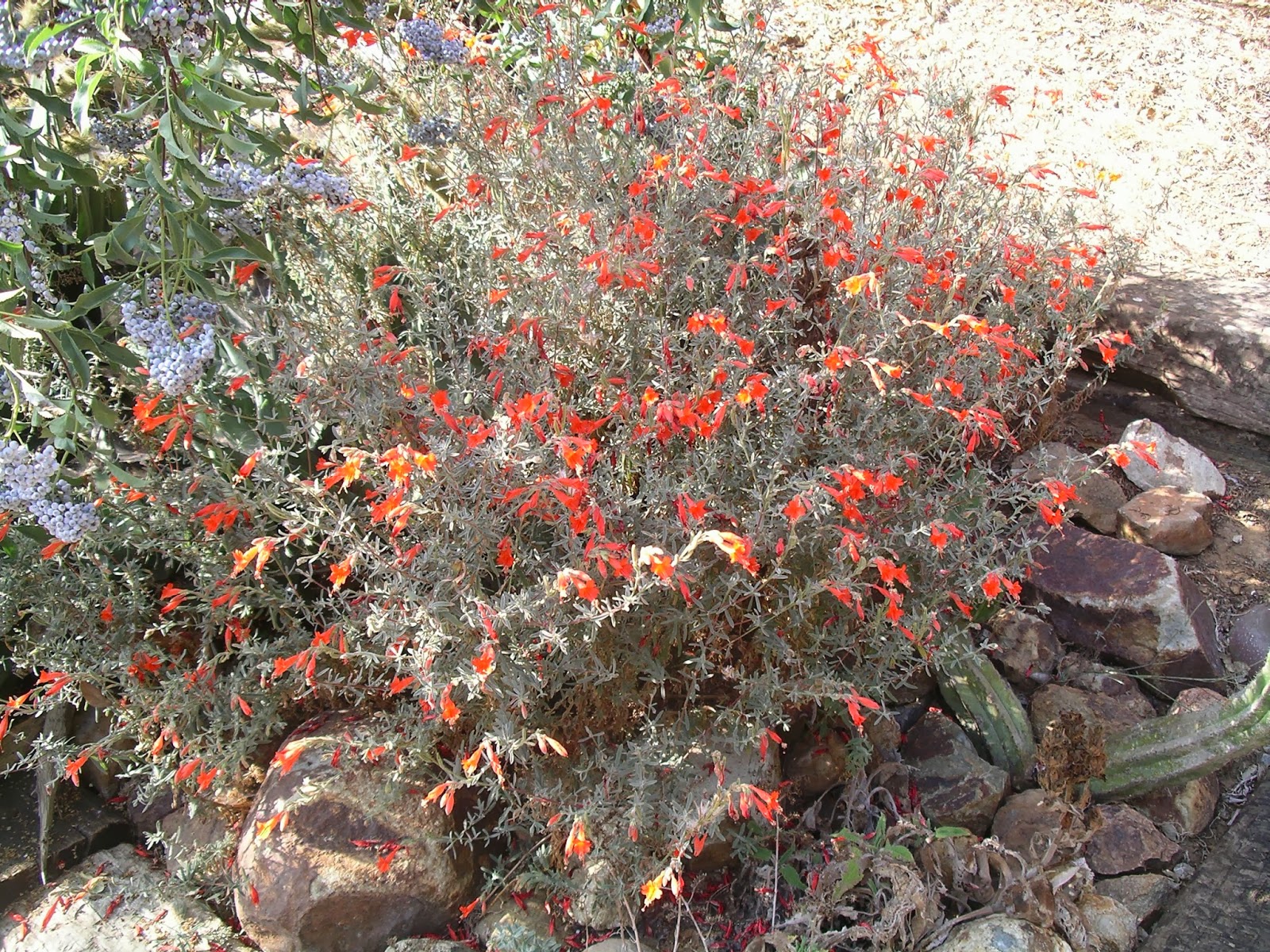
The other plant that is blooming (profusely) now is Epilobium canum (California fuchsia). It is a very reliable late summer bloomer that spreads itself readily by rhizomes and seeds. In fact, it is a bit too aggressive in its spreading, and I am always having to pull it out of places where I don't want it to take over. Aside from that it's a great plant that is much appreciated by insects and hummingbirds at this time of year.
Now that I'm back in SoCal, the primary order of business is getting ready for Fall planting. I have made a list of the places in the garden where plants are needed and species that I want to buy. Most of them are ones that I already have and want to have more of. At this time, my wish list is as follows:
- Allium haematochiton - Redskin onion
- Aquiligia formosa - Western columbine
- Asclepias fascicularis -Narrow leaf milkweed
- Eriogonum arborescens and E. gigantea - Santa Cruz Island buckwheat and St. Catherine's lace
- Lysiloma candidum (not sure about this one) - Palo blanco
- Monardella linoides ssp. viminea - Willlowy monardella
- Rosa minutifolia - Small-flowered rose
- Salvia brandegei - Santa Rosa Island sage
- Clinopodium (Satureja) chandleri - San Miguel Savory
- Solanum hindsianum - Baja nightshade
- Ribes malvaceum 'Dancing Tassels' - Dancing tassels currant
- Hazardia dentosa - Island bristleweed
- Styrax officinalis - Snowdrop bush
- Cneoridium dumosum - Spicebush
- Penstemon sp.
- Trichostema lanatum - Woolly bluecurls
- Acmispon americanus (formerly Lotus purshianus) - Spanish lotus
- Hulsea heterochroma - Red-rayed hulsea
- Phacelia tanacetifolia - Tansy leafed phacelia
- Clarkia amoena - Farewell to Spring
- Clarkia unguiculata - Woodland clarkia
- Castilleja exserta - Owl's clover
- Gilia tricolor - Bird's eye gilia
- Eschscholzia californica - Calif. poppy
- Lupinus succulentus - Arroyo lupine
- Layia platyglossa - Tidy tips
- Phacelia grandiflora - Large flowered phacelia
- Clarkia bottae - Botta's clarkia
- Cirsium occidentale - Cobweb thistle
I have been watering it every 2 weeks during the summer to simulate the kinds of rain it would get in central and southern Baja. Lately we have been having some clear, warm days which made this plant feel right at home. I have it in a fairly large pot where it will hopefully be happy for a long time.
The other plant that is blooming (profusely) now is Epilobium canum (California fuchsia). It is a very reliable late summer bloomer that spreads itself readily by rhizomes and seeds. In fact, it is a bit too aggressive in its spreading, and I am always having to pull it out of places where I don't want it to take over. Aside from that it's a great plant that is much appreciated by insects and hummingbirds at this time of year.
Subscribe to:
Posts (Atom)